

Fine Motor Skills Without Turning Your Kitchen Table Into Preschool Boot Camp.
Coloring, tracing, mazes, and dot-to-dots as playful practice for little hands. No laminator required.
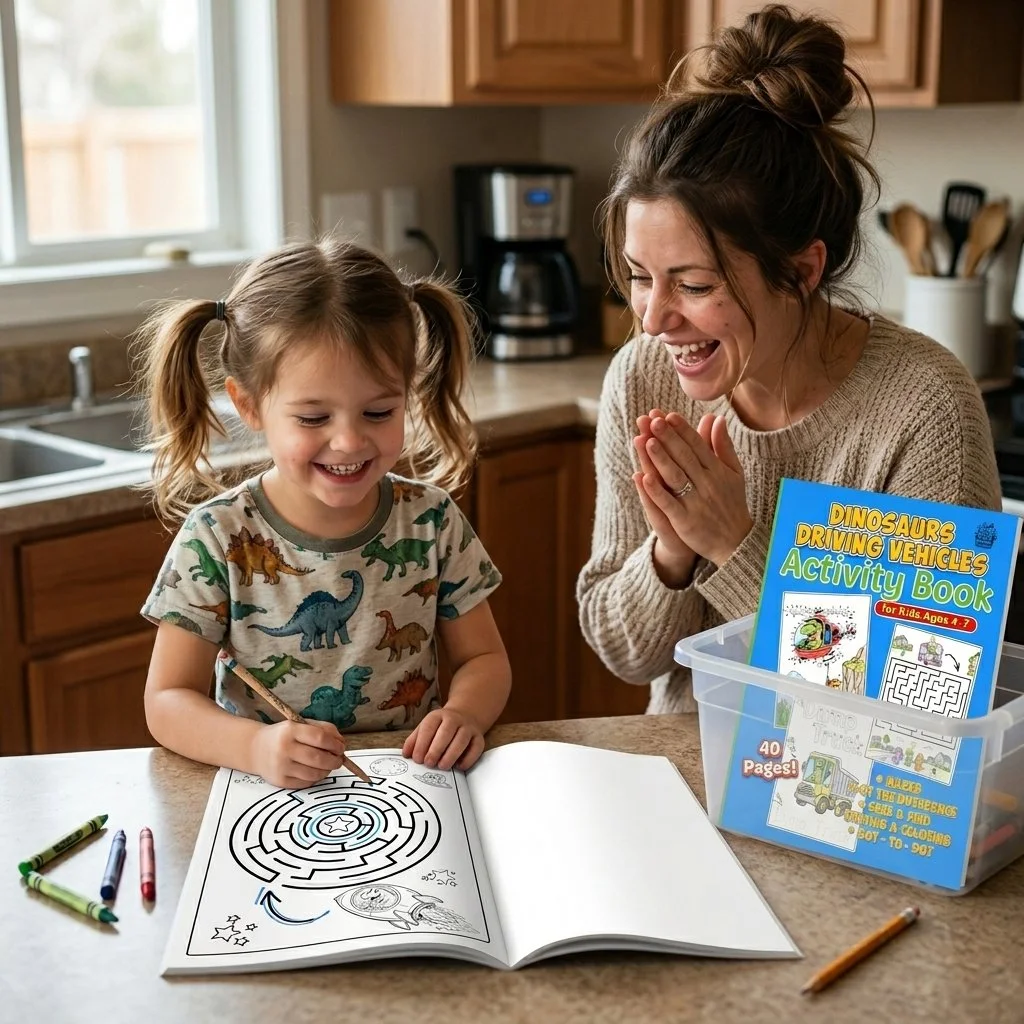
Staying in the lines is a skill. Not a moral achievement.
The takeaway
Coloring can support fine motor practice.
But the second we turn it into a performance review, we’ve lost the plot.
Kids need chances to practice grasp, pressure, line-following, hand strength, and visual-motor coordination. Coloring and activity books can offer that in a playful, low-pressure way.
The point is practice.
Not perfection.
No one needs a three-year-old’s giraffe to stay inside the lines.
The giraffe will survive.
Honestly, the giraffe has been through enough.
The real-life problem
Modern parents hear a lot about school readiness.
We want our kids prepared. We want them confident. We want them to be able to hold a pencil without looking like they are wrestling a crab.
Reasonable goals.
But readiness advice can get intense fast.
Suddenly a simple coloring page becomes a developmental checkpoint.
Is the grip correct?
Are they crossing midline?
Did they color neatly?
Are they behind?
Should we be doing more?
Is there a workbook?
There is always a workbook.
Of course there is.
Deep breath.
Coloring is most useful when it stays playful.
Not when it becomes a tiny unpaid internship in kindergarten preparation.
What coloring practices
A coloring page gives children repeated chances to use small hand movements in a low-stakes setting.
They practice:
Holding a crayon or pencil.
Adjusting pressure.
Moving across a page.
Following lines or boundaries.
Coordinating eyes and hands.
Finishing a small task.
Activity books add other helpful skills.
Mazes encourage planning and control. Dot-to-dots support sequence and direction. Tracing builds line confidence. Matching pages support visual scanning.
All useful.
None of it needs to be dramatic.
We do not need a clipboard and a serious face.
Choose pages that fit your child
If the page is too detailed, the child may give up.
If the page is too babyish, the child may reject it on principle, with the offended dignity of a tiny art critic.
For younger preschoolers, choose big shapes and bold outlines.
For older preschoolers and kindergarten-age kids, add simple mazes, tracing, dot-to-dots, and pages with a little more detail.
Keep the session short.
Five to ten minutes of happy practice beats thirty minutes of everyone hating crayons.
Which, surprisingly, is not the goal.
Praise the useful things
Try not to praise neatness first.
Instead, say:
“You worked carefully on that part.”
“You tried a new color.”
“You kept going even when that line was tricky.”
“Your hand is getting stronger.”
“You made a choice and finished your page.”
This keeps the focus on effort, control, and confidence instead of making the child feel like the coloring page is being graded.
Because truly, who among us needs another evaluation system at the kitchen table?
We already have snack reviews, outfit protests, and one-person juries deciding dinner is “weird.”
What about staying in the lines?
Staying in the lines is a skill.
Not a moral achievement.
Some kids care. Some do not. Some are still in the glorious scribble era, where every page becomes a festival of motion.
Wonderful.
Scribbling is part of development too.
If your child wants help, model slowly.
“I’m going around the edge first, then filling the middle.”
If they do not want help, let the purple tornado be.
The goal is to make hands stronger and more confident.
Not to create a museum-ready tractor.
The tractor does not need to go to the Louvre.
What this does NOT fix
Coloring will not solve significant fine motor delays on its own.
If your child struggles with hand strength, coordination, daily tasks, or frustration in a way that worries you, it may be worth asking a pediatrician, teacher, or occupational therapist for guidance.
A coloring book can be part of practice.
It is not a replacement for support when support is needed.
Crayons are useful.
They are not a medical team.
The tiny reset to try today
Choose one simple page and one fine motor goal.
Not ten goals.
One.
Maybe: hold the crayon with fingers and thumb.
Maybe: try coloring one small section slowly.
Maybe: complete one short maze.
Maybe: trace three lines.
Set a five-minute timer.
When the timer ends, stop while it still feels good.
That is the sweet spot.
A little practice.
A little confidence.
No boot camp.
No regrets.
Just a stronger crayon hand.