

Feelings Are Hard. Colors Help.
How coloring can open the door to emotions when “How was your day?” gets you absolutely nowhere.
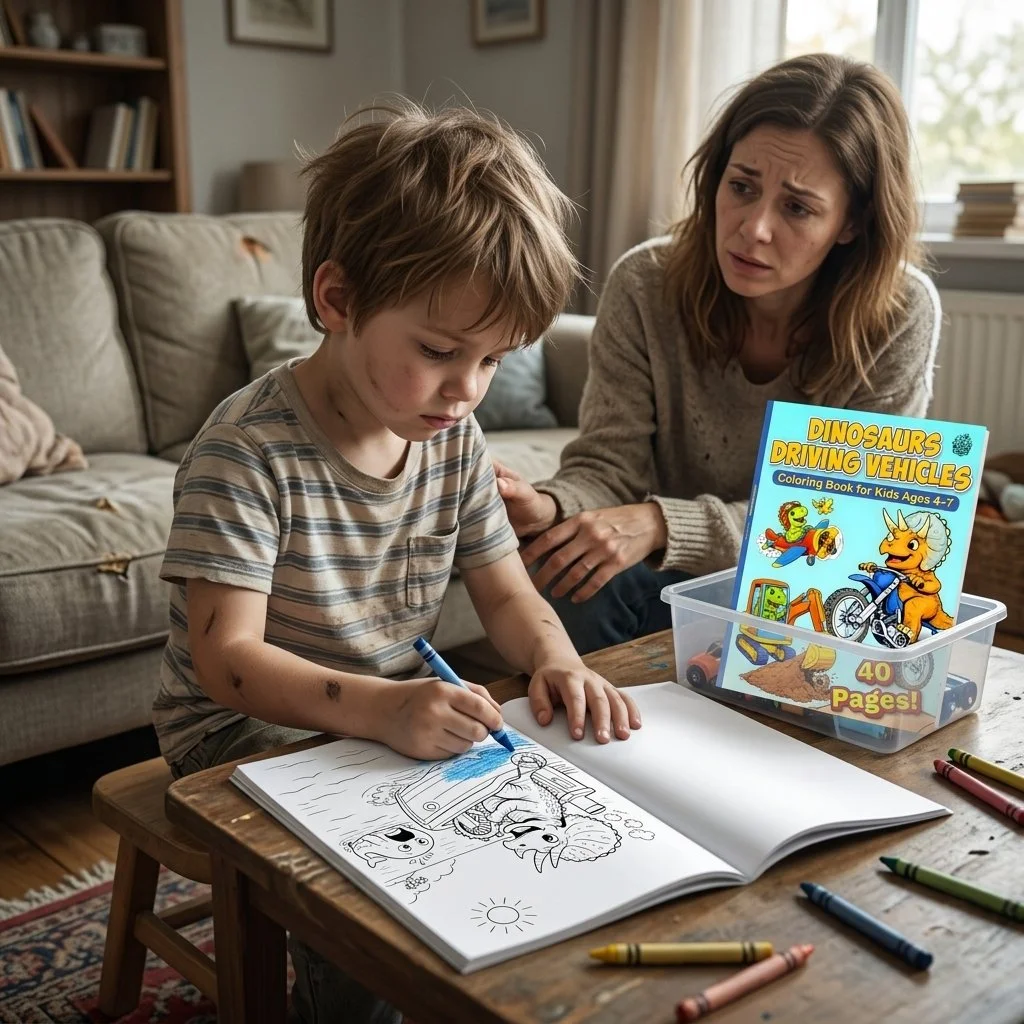
“Pick one color for how today felt.” Then wait.
The takeaway
Some children can tell you exactly how they feel.
Other children respond to “How was your day?” with “fine,” “I don’t know,” or a sound normally made by a tired goat.
Helpful. Very rich data.
Coloring can help because it gives feelings a side door.
A child may not be ready to explain the playground drama, but they might be able to pick a stormy blue, a mad red, a tired gray, or a happy yellow.
The color gives them a starting place.
Not therapy.
Not a diagnosis.
Not a full emotional breakthrough over washable crayons.
Just an easier opening.
The real-life problem
Parents are told to talk about feelings.
This is good advice.
Also, have the advice-givers met children?
Direct questions can feel too big. “How are you feeling?” may sound simple to us, but for a child it can require body awareness, emotional vocabulary, memory, trust, timing, and the ability to talk while someone is staring at them lovingly from across the table.
No pressure, kiddo.
Please summarize your inner world while I hover with deep concern.
A coloring page lowers the intensity.
You can sit beside each other instead of face-to-face. The hands are busy. The conversation can wander in slowly.
Which, for a lot of kids, is the only way the conversation was ever going to arrive.
Try a color check-in
Keep it easy.
Say:
“Pick one color for how today felt.”
Then wait.
Maybe your child colors the whole dinosaur black because recess was hard.
Maybe they choose green because lunch had grapes.
Maybe they pick every color because they are four and every color is the correct color.
All useful information, frankly.
If they share more, listen.
If they do not, don’t pry.
The goal is to make feelings approachable, not to extract a full report like you’re running a tiny HR department with snack crumbs on the floor.
Use the page as a bridge
Here are a few gentle prompts:
“Which part of the page feels calm?”
“What color is your body right now?”
“Is there a mad color today?”
“Should we add a color for tired?”
“What color should tomorrow start with?”
These are small enough for tired kids.
They also help parents avoid the classic trap of asking a giant question at the exact wrong time.
A question like, “Tell me everything that happened today and how you feel about it,” asked while the child is upside down on the couch and emotionally held together by one cracker.
Beautiful idea.
Terrible timing.
When to use it
Color feelings can work well:
After school.
Before bed.
After a hard transition.
During a calm-down period after tears.
When a child wants connection but not direct conversation.
Do not try it at peak meltdown.
At peak meltdown, the feeling is already obvious.
The feeling is everywhere.
The feeling has taken over the living room, possibly the hallway, and at least one throw pillow.
Use coloring after the nervous system has come down a notch.
That is when the side door may actually open.
What this helps with
Coloring can support emotional labeling and nonverbal expression.
It gives a child a way to show something before they can say it.
For some kids, this is much easier than talking.
For others, it simply makes the conversation feel less formal.
It can also help parents.
Instead of launching straight into advice, we get to notice first.
“I see you used a lot of red today.”
That is a calmer start than:
“Tell me what happened and why are you upset and did you use your words?”
Ask me how I know.
Actually, don’t. We’re all trying to grow here.
What this does NOT fix
A feelings-color page will not resolve serious anxiety, trauma, chronic emotional distress, or ongoing school problems.
It can help create a habit of expression.
It can help you notice patterns.
It can help a child feel seen in a low-pressure way.
But if the feelings are big, persistent, or concerning, the coloring page is a doorway.
Not the whole house.
Crayons are useful.
They are not licensed professionals.
The tiny reset to try today
Print or choose one simple page.
Ask:
“What color is today?”
Then color beside your child for five minutes.
If they talk, listen.
If they do not talk, let the colors do their quiet little job.
Feelings are hard.
Colors help.
And some days, that is a very good place to begin.