

Why “Just Go Play” Doesn’t Always Work.
Some kids need a starting point, a boundary, and a visible finish line. Activity books quietly offer all three.
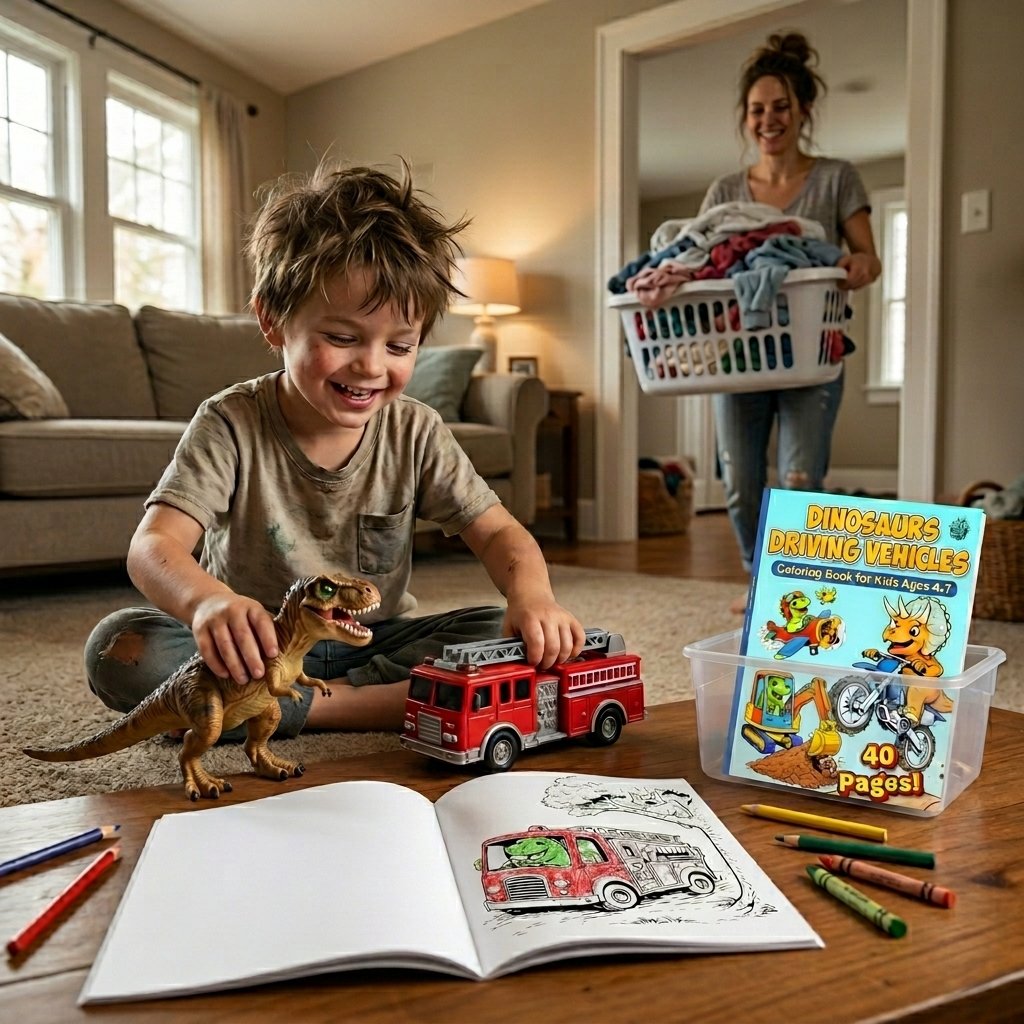
Choose one activity page that matches your child’s current obsession.
The takeaway
“Just go play” sounds simple.
And for some kids, it works beautifully. They wander off and build a spaceship out of couch cushions and spoons.
Lovely.
Enjoy your unicorn child.
For other kids, “just go play” is too open.
Too many choices.
No starting point.
No clear job.
No visible end.
Basically, you’ve handed them the entire concept of childhood and said, “Good luck.”
Activity books can help because they give structure without requiring constant adult direction.
A gift. A small paper miracle. No assembly required.
The real-life problem
Open-ended play is wonderful.
It’s also not always where kids start.
Some children need help entering play. They may be tired, overstimulated, unsure, clingy, bored, or overwhelmed by too many toy options.
A room full of toys can still somehow produce, “I have nothing to do.”
Painful.
But also understandable.
Too much choice can feel like no choice at all. Adults do this too. I have stood in front of a full refrigerator and declared there is no food.
So there we are, modeling executive function beautifully.
Why activity books help
Activity books narrow the task.
A maze says: get from here to there.
A dot-to-dot says: follow the numbers and see what appears.
A coloring page says: choose a color and begin.
A hidden-picture page says: find the thing.
Your child does not have to invent the whole activity from scratch.
The page gives them a doorway.
This is especially useful during those awkward little gaps when there isn’t enough time to launch a full pretend-play universe, but there is absolutely enough time for everyone to hover around the adult like tiny bored satellites.
Use it as a bridge into play
Activity books do not have to replace open-ended play.
They can lead into it.
A child colors a fire truck, then starts pretending to rescue stuffed animals.
A child finishes a dinosaur maze, then builds a block road.
A child colors a boat, then turns the couch into the ocean.
The page can be the spark.
Not the whole fire.
This is why themes matter. Choose pages related to your child’s actual interests. Dinosaurs, vehicles, animals, space, bugs, fairies, construction, whatever current obsession is running your house like an unpaid manager with strong opinions.
Interest is the hook.
Obviously the tiny tyrant has preferences.
What to say
Instead of “go play,” try:
“Pick one page to start. Then you can build the scene with toys.”
“Color the truck, then make a road for it.”
“Do this maze while I finish my message. Then I’ll see what you made.”
“Choose one activity from the book. I’ll check in when the timer beeps.”
These phrases give a start and an end.
That helps.
Because “go entertain yourself indefinitely with no plan” is apparently not the crystal-clear instruction adults imagine it to be.
What this helps with
Activity books support focus, decision-making, and short independent play windows.
They can be especially helpful for kids who need structure before they can move into more open play.
They also help parents because they reduce the need to invent entertainment on demand.
We can love our children deeply and still not want to be the cruise director of every waking moment.
Both things can be true.
Please alert the internet.
What this does NOT mean
This does not mean kids should always be given structured activities.
Boredom matters.
Free play matters.
Wandering around complaining until imagination kicks in probably matters too, though I will not be putting it on a motivational poster.
Activity books are one tool.
Use them when your child needs a starting point or when the family needs a short, contained activity.
Then let the play expand when it can.
Not everything needs a worksheet.
But sometimes a worksheet is the bridge between chaos and “Oh look, they’re doing something.”
The tiny reset to try today
Choose one activity page that matches your child’s current obsession.
After they finish, ask, “What could happen next in this picture?”
Then see if they want to build, pretend, draw more, or tell a story.
If yes, great.
If no, they still completed a short activity while you did what you needed to do.
Also great.
A starting point is not a failure of imagination.
Sometimes it is how imagination gets warmed up.
Very inconvenient for the “kids should just magically know what to do” crowd, but here we are.